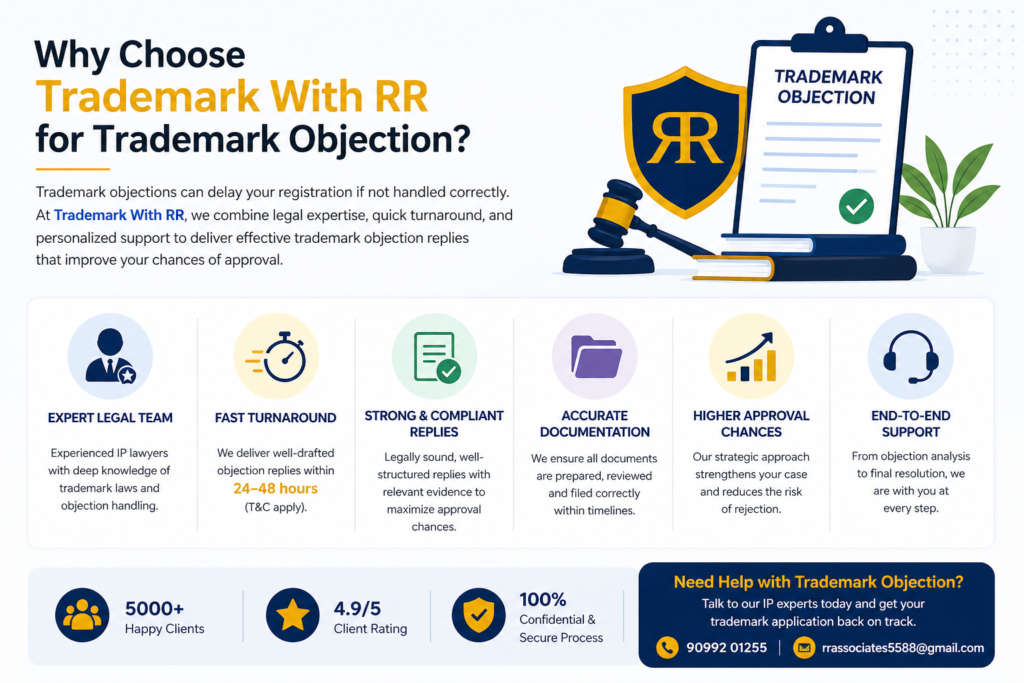


Trademark Objection response in India
A trademark objection in India occurs when the Trademark Registry raises concerns regarding your trademark application during the examination stage. These objections are usually mentioned in the examination report and may arise due to similarity with existing trademarks or lack of distinctiveness.
Trademark objections are a common part of the trademark registration process and do not mean rejection. With a proper and timely response, your application can still proceed towards approval.
Common Reasons for Trademark Objection:
• Similarity with Existing Trademarks
If your trademark is identical or closely resembles an already registered mark, it may cause confusion among consumers.
• Lack of Distinctiveness
Generic or descriptive names that do not clearly identify your brand may face objections.
• Misleading or Deceptive Marks
Trademarks that may mislead customers about the nature, quality, or origin of goods/services can be objected.
• Use of Restricted or Offensive Terms
Marks containing prohibited words, symbols, or inappropriate content may be rejected by the authority.
• Incorrect Trademark Classification
Filing under the wrong class may also result in objections.
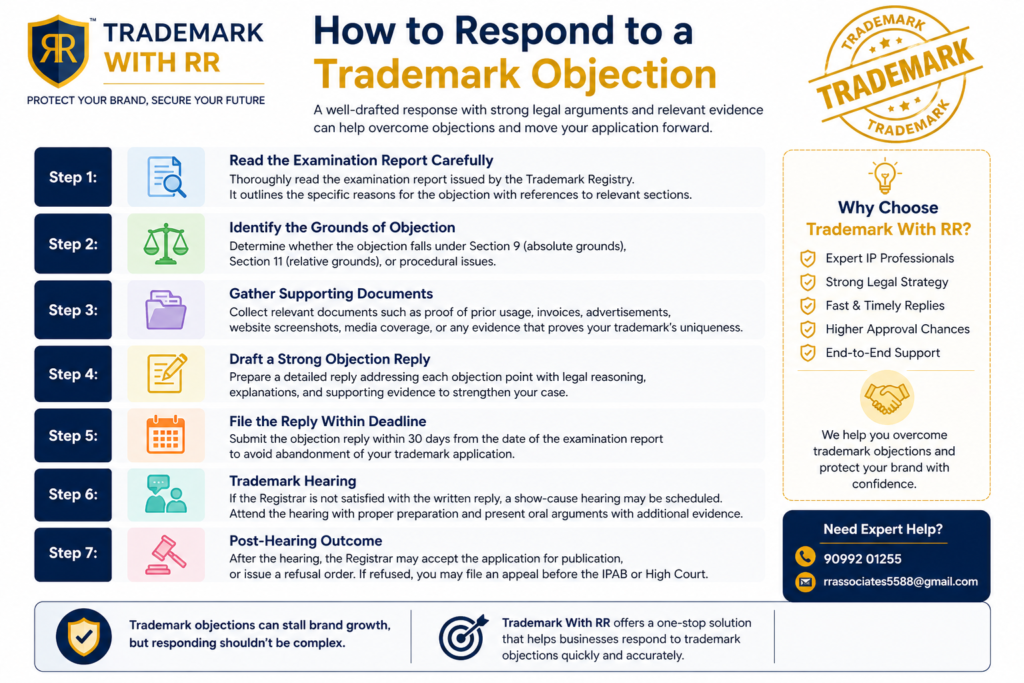
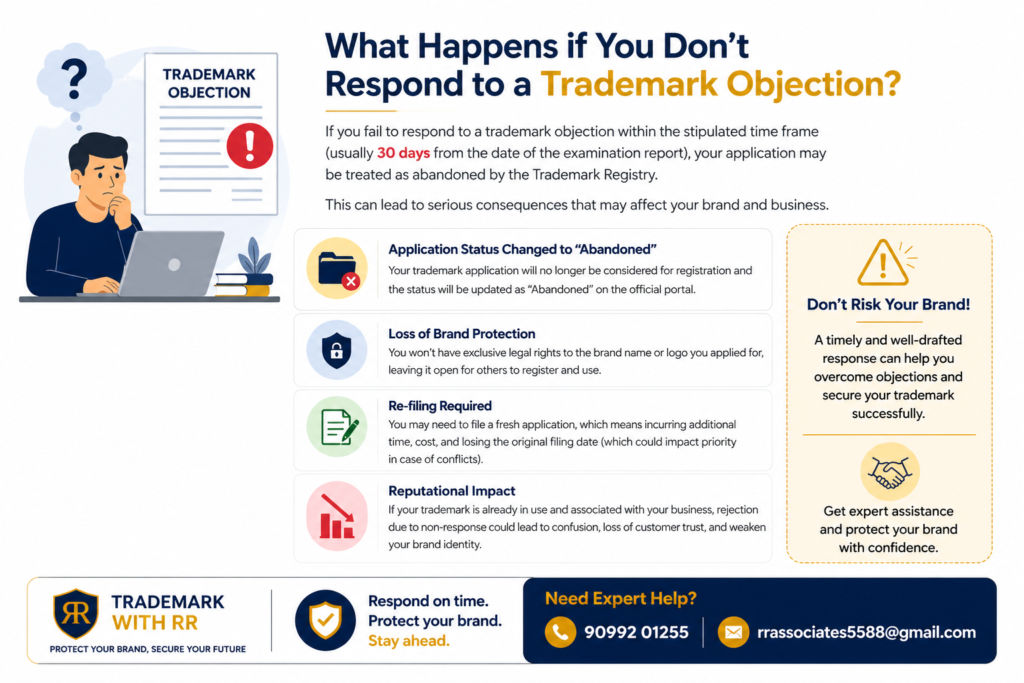
To overcome a trademark objection, the applicant must file a detailed objection reply within 30 days of receiving the examination report. A well-prepared response with proper justification and supporting documents can significantly improve approval chances.
Seeking expert guidance ensures that your objection reply is legally strong, accurate, and increases the likelihood of successful trademark registration.
Don’t let objections delay your brand protection—get expert help and secure your trademark efficiently.
• What is a Trademark Objection?
A trademark objection is raised when the Trademark Registry finds issues with your application during examination. It means your trademark is under review and requires a proper response before approval.
Objections are usually based on reasons like similarity with existing trademarks, lack of uniqueness, or incorrect classification under the Trade Marks Act, 1999.
A trademark objection does not mean rejection. It simply indicates that the applicant must submit a detailed reply within 30 days to justify and defend the trademark.
With a well-prepared objection reply supported by valid arguments and documents, your application can successfully proceed towards registration.
Responding quickly and correctly is the key to overcoming trademark objections and securing your brand legally.
Trademark objections in India are raised when the Trademark Registry finds issues during the examination of a trademark application. These objections are mainly based on Sections 9 and 11 of the Trade Marks Act, 1999, along with other common procedural reasons.
Understanding the grounds for objection helps applicants respond effectively and improve the chances of successful registration.
Objections Under Section 9 (Absolute Grounds)
• Lack of Distinctiveness
Trademarks that are generic, descriptive, or commonly used may be objected.
• Misleading or Deceptive Marks
Marks that misrepresent the quality, nature, or origin of goods/services.
• Prohibited or Offensive Content
Trademarks containing obscene, religiousl ysensitive, or restricted terms may face objections.
Objections Under Section 11 (Relative Grounds)
• Similarity with Existing Trademarks
If your trademark is identical or similar to an already registered mark, it may cause confusion among consumers.
• Likelihood of Confusion
Marks that may mislead customers about the source of goods/services can be objected.
Other Common Reasons for Trademark Objection
• Incorrect Trademark Class Selection
• Incomplete or incorrect application details
• Use of restricted words or national symbols
• Conflict with well-known trademarks
Identifying these grounds early and submitting a strong objection reply can help avoid rejection and ensure smooth trademark registration.
• Documents Required for Trademark Objection Reply
Documents Required for Trademark Objection Reply
Submitting the right documents is essential while filing a trademark objection reply in India. Proper documentation strengthens your response and helps prove the uniqueness and validity of your trademark.
Key Documents Required:
• Authorization (TM-48)
This document authorizes a trademark agent or attorney to represent the applicant. It must be signed and properly executed.
• Examination Report & Application Details
A copy of the examination report along with the trademark application number is required to address the objections accurately.
• Identity Proof
Valid ID proof such as PAN card, Aadhaar card, passport, or voter ID is needed for verification of the applicant.
• Address Proof
Proof of address like utility bills, bank statements, or official documents confirming the applicant’s address.
• Affidavit of Usage (if applicable)
An affidavit stating the first use of the trademark, including details of usage and duration.
• Proof of Trademark Usage
Supporting documents such as invoices, product packaging, brochures, website screenshots, advertisements, and social media presence to demonstrate commercial use.
Providing complete and accurate documents improves the chances of approval and ensures a smooth trademark objection resolution process.
Get expert assistance to prepare and file your trademark objection reply with confidence. –https://trademarkwithrr.com/
• Trademark Objection Reply Fees in India
There is no official government fee for filing a trademark objection reply in India when the applicant submits it directly through the IP India portal. However, professional assistance is often recommended to ensure a strong and effective response.
Trademark objection reply fees typically depend on factors such as the complexity of the objection, the number of issues raised, and the level of legal expertise required.
Professional Service Charges:
Trademark objection reply services generally start from ₹2,999 + GST*. The final cost may vary based on the nature of the objection, documentation required, and case complexity.
Investing in expert support increases the chances of approval and helps avoid rejection or delays in the trademark registration process.
For accurate pricing and consultation, connect with our trademark experts and get a clear estimate for your case.
Difference Between Trademark Objection and Trademark Opposition
Trademark objection and trademark opposition are two important stages in the trademark registration process in India. Although both involve challenges to your trademark application, they differ in timing, authority, and purpose.
Trademark Objection
A trademark objection is raised by the Trademark Registrar during the examination stage of your application. It occurs before the trademark is published in the Trademark Journal.
• Raised by: Trademark Examiner
• Stage: Examination phase
• Purpose: To check legal validity under Sections 9 & 11
• Action Required: Submit a trademark objection reply with supporting documents
• Time Limit: Usually within 30 days
Trademark Opposition
Trademark opposition is filed by a third party after your trademark is published in the Trademark Journal. It is a legal challenge against your trademark registration.
• Raised by: Third party or competitor
• Stage: After publication in Journal
• Purpose: To prevent registration due to conflict or prior rights
• Action Required: Legal response and hearing process
• Time Limit: Within 4 months from publication
Key Difference
While a trademark objection is an internal review by the Registrar, a trademark opposition is an external challenge raised by another party.
Understanding this difference helps you take the right action at the right stage and improves your chances of successful trademark registration.